Gold guides
10 facts about gold you probably didn't know
Ten true facts about gold, from neutron stars and Olympic medals to what 916 means and gold mining at Vatukoula in Fiji.
3 min readChecked
We spend our days handling gold, and it still surprises us. Here are ten facts about it that we find interesting, all of which we've checked.
1. Much of the universe's gold was made in collisions between stars
Gold is too heavy to be made in ordinary stars. Scientists now think much of it forms when two neutron stars collide, in an explosion called a kilonova. In 2017, astronomers watched one of these collisions happen and detected the signature of heavy elements being made. The gold in a bangle was formed long before the Earth existed.
2. Gold does not rust or tarnish
Pure gold does not react with oxygen or water, which is why gold coins recovered from old shipwrecks can still look bright. Jewellery is a little different. 22ct, 18ct and 9ct gold are alloys with other metals mixed in, and the more gold in the alloy, the longer it keeps its bright colour. That is one reason 22ct stays so rich, and a gentle clean brings back the shine.
3. A tiny piece of gold can cover a table
Gold is the most malleable metal. A piece smaller than a pea can be beaten into a sheet of roughly one square metre. Gold leaf is so thin that light passes through it, and it is the same material used to decorate temples, picture frames and sweets.
4. You can eat it
Edible gold leaf is used on desserts and sweets around the world. Pure gold is inert, so it passes through the body without being digested. It adds no flavour at all, only shine.
5. Olympic gold medals aren't solid gold
The last solid gold Olympic medals were awarded at the 1912 Stockholm Games. Since then, gold medals have been made mostly of silver with a coating of gold. The jewellery in our cases has far more gold in it: 22ct is 91.6% gold all the way through.
6. 916 is a fraction
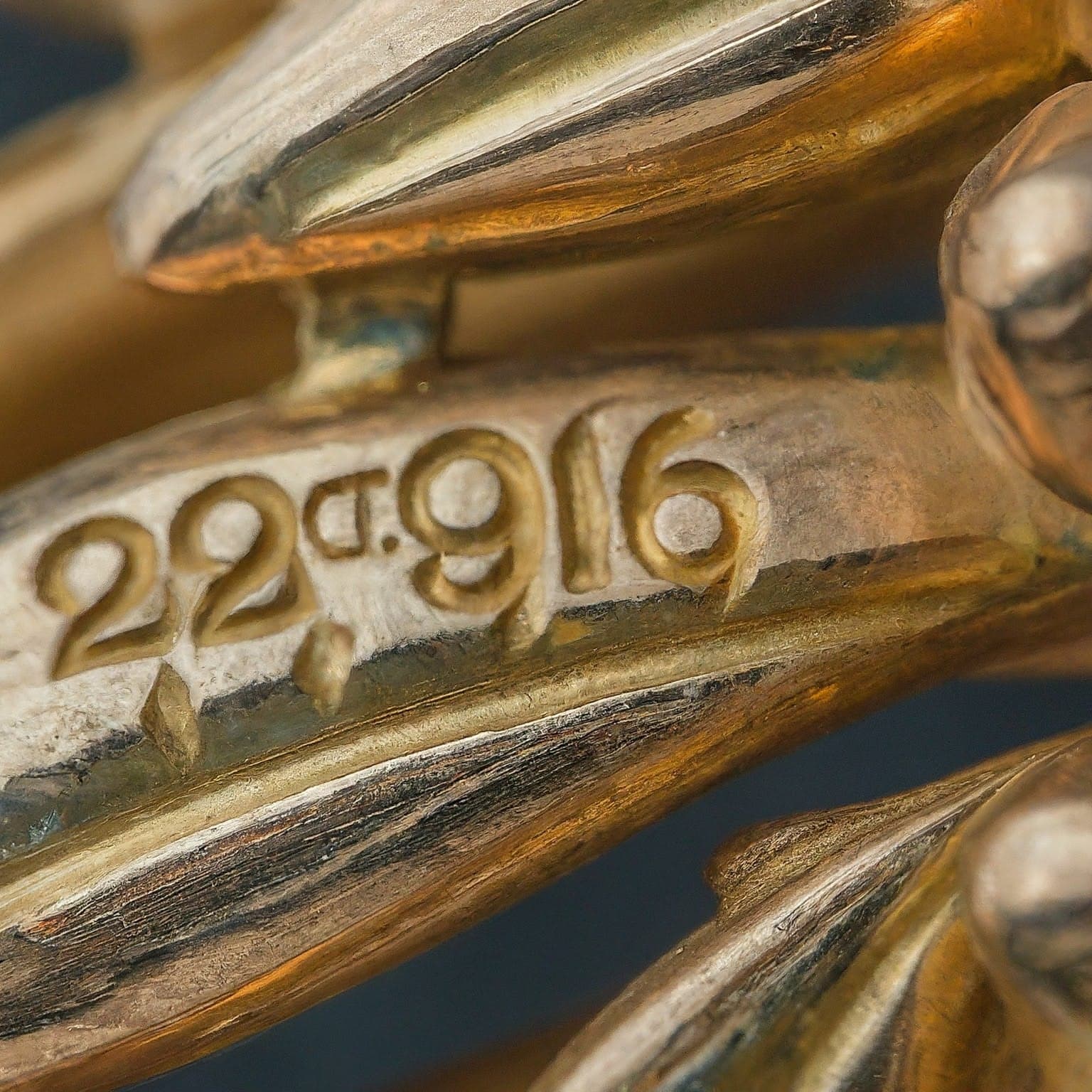
Gold purity is measured in carats out of 24, so 24ct is pure gold. 22ct means 22 parts gold out of 24, which works out to 91.6%. That is why 22ct jewellery is stamped 916. In the same way, 18ct is stamped 750 (75%) and 9ct is stamped 375 (37.5%). Our post on what 22ct actually means explains the numbers in more detail.
7. Fiji has its own gold mine
Gold has been mined at Vatukoula, near Tavua in the north of Viti Levu, since the 1930s. The town grew up around the mine, and for decades gold was one of Fiji's important exports.
8. The largest alluvial nugget was found in Australia and melted down
The Welcome Stranger nugget was found at Moliagul in Victoria in 1869, just below the surface. It held more than 70 kg of gold. It was too big for the scales of the day, so it was broken into pieces and soon melted down. Only replicas of it exist today.
9. Fort Knox holds about half of the US gold reserve
The United States holds the largest official gold reserve in the world, about 8,100 tonnes. Fort Knox in Kentucky holds roughly 4,580 tonnes of that, a little more than half. The rest is held at other US government sites, including the US Mint at West Point and Denver.
10. There is gold in your phone
Gold conducts electricity well and does not corrode, so tiny amounts are used on connectors and circuit boards in phones and computers. It has a long history in medicine too: gold compounds were used for decades to treat rheumatoid arthritis, though newer medicines have largely replaced them.
Seeing it for yourself
Facts are one thing, but the colour of 22ct gold is best seen in person. If you'd like to compare 22ct, 18ct and 9ct side by side, ask us in the shop and we'll show you the difference. You can also browse our gold jewellery online.