Care & style
Gold bangles: what they mean and how to stack them
Why bangles matter in Fiji Indian families, the traditions behind them, the main 22ct gold styles, and simple ways to build a stack you'll wear every day.
4 min read
The soft chime of bangles is one of the most familiar sounds in a Fiji Indian home. A grandmother's thin gold bangles that never come off, a bride's wrists full of gold on her wedding day, a single bangle given to a daughter on her 21st: bangles carry a lot of meaning for something so simple.
Here is a little about where that meaning comes from, the styles you'll see, and how to wear them well.
A very old piece of jewellery
Bangles are one of the oldest kinds of jewellery in South Asia. A famous bronze figure from Mohenjo-daro, more than 4,000 years old and known as the "Dancing Girl", wears one arm almost completely covered in bangles. People have been stacking bangles for a very long time.
The word bangle itself comes from the Hindi bangri or bangdi, meaning a glass bracelet. In Fiji you'll also hear gold bangles called kangan.
What bangles mean
For a bride
In many Indian communities, bangles are among the traditional signs of a married woman, alongside the mangalsutra and sindoor. Customs differ:
- In Punjabi families, the bride wears the chooda, a set of red and white bangles, often given by her maternal uncle.
- In Bengali families, the bride wears shakha (white conch shell) and pola (red coral) bangles, often with an iron bangle edged in gold.
- In many North Indian, Gujarati and South Indian families, gold bangles are part of the jewellery a bride receives and keeps.
Among Fiji Indian families, 22ct gold bangles are a common part of the bridal jewellery, often worn with glass bangles in colours that match the wedding outfit. Our Fiji Indian wedding jewellery guide has more on what families usually give.
Beyond the wedding
Gold bangles are also given to mark milestones: a baby's first small bangles, a teenager's first pair, a 21st birthday, a graduation. Many women add to their collection over the years, so their bangles become a record of the moments that mattered. Our guide to gold gifts for babies, birthdays and graduations has more ideas.
The main styles
Plain and patterned bangles
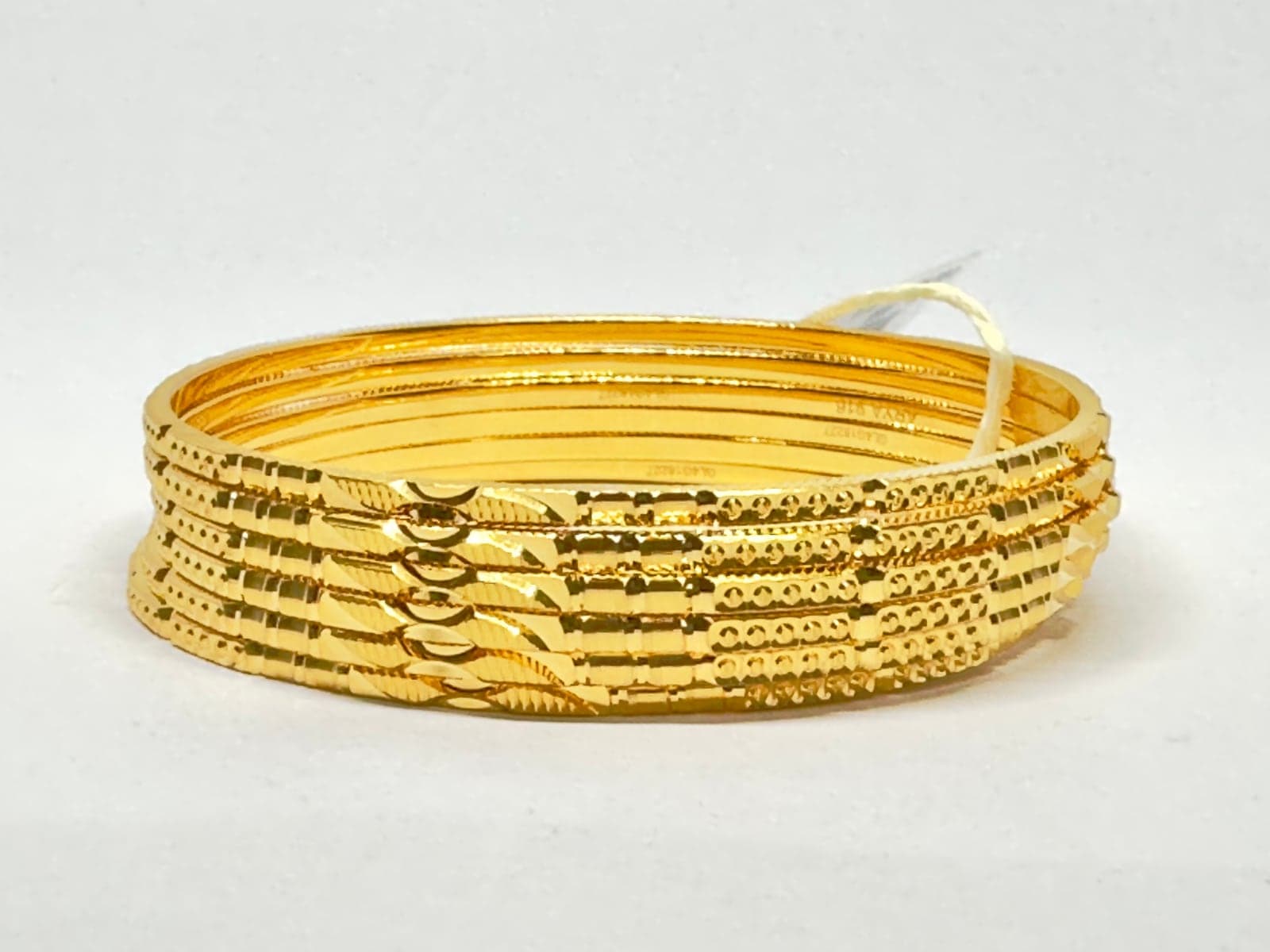
Slim bangles, smooth or with a light pattern, are the everyday classic. Many are finished with a diamond-cut pattern, like the stack in the photo above, which carves tiny facets into the gold so it sparkles as the wrist moves. Our guide to gold finishes explains how this is done.
Kangan and kada
Kangan is the everyday Hindi word for a bangle, and many families use it for any gold bangle. A kada is a thicker, heavier style, often worn on its own. For women, a detailed gold kada makes a statement at weddings and festivals. Men also wear plain or patterned kadas; in the Sikh faith, the steel kara is one of the five articles of faith.
Filigree and openwork
Lacy, open bangles made from fine gold wire or cut-out patterns. They look generous and detailed without being as heavy as a solid bangle of the same width.
Stone-set and two-tone
Bangles set with coloured or white stones, or mixing yellow and white gold, are often chosen to match a bridal or party outfit.
Openable bangles
Some bangles open on a hinge or screw. They are easier to put on if the hand is wider than the wrist, and they suit people who find solid bangles hard to slide over the knuckles.
How to build a stack
Start with a pair
A matching pair of slim bangles, one on each wrist or both on one, is the simplest place to start. It looks complete on its own and leaves room to add more.
Use an even number
Many families prefer to wear bangles in even numbers, especially for weddings. It's worth asking the elders if you're putting together a bride's set.
Mix widths
A wider bangle or kada in the middle, with slim bangles either side, gives a stack shape and stops it looking flat.
Mix textures
Combine a polished bangle with a diamond-cut one and a filigree one. The different finishes catch the light in different ways, and the stack looks richer than a row of identical pieces.
Keep the colour consistent
22ct gold has a deep, warm colour. If you mix 22ct with 18ct or 9ct, the colours will look slightly different side by side. That can be lovely, but it's worth seeing them together first. Our 22ct, 18ct and 14ct comparison explains why.
Balance with a watch
Wear your watch on one wrist with one or two slim bangles, and keep the fuller stack on the other. Your watch face will thank you.
Everyday wear
Plenty of women wear thin 22ct bangles every day without taking them off. 22ct gold is soft, though, so a few habits help:
- Take bangles off for the gym, gardening and heavy housework, where they can be dented.
- Store them flat or on a bangle stand, not loose in a drawer.
- Wipe them with a soft dry cloth to bring back the shine.
Our 22ct gold care guide has the full routine.
Getting the size right
Bangles are sized by their inside diameter, because a solid bangle has to slide over the hand. The easiest way is to measure across the inside of a bangle that already fits well. Our ring and bangle size guide explains how to measure from home.
Bangles at Shreeji Jewellers
We keep a wide range of 22ct gold bangles at our shop on Main Street, Nadi, from slim everyday pairs to detailed wedding pieces, and every one is stamped 916. You can see more on our gold bangles page. Bring a bangle that fits, or its inside measurement, and try a few combinations until the stack feels like yours.